
We provide advanced audio-visual technologies to create future-ready corporate, educational, and healthcare environments.
We provide advanced audio-visual technologies to create future-ready corporate, educational, and healthcare environments.

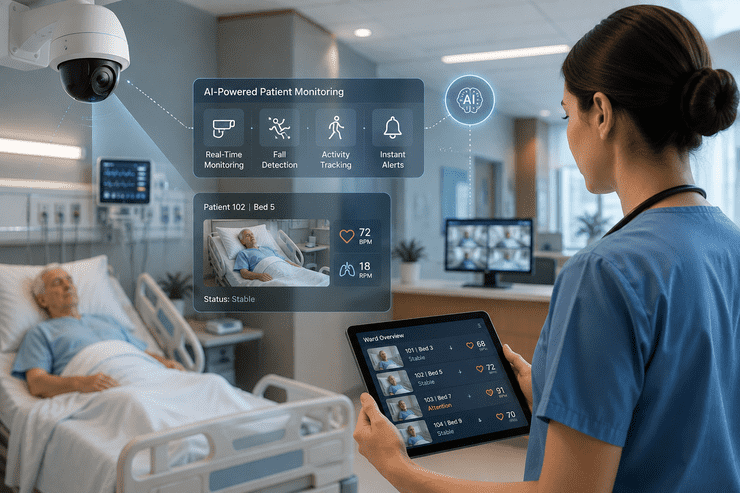
Ward rounds have traditionally depended on staff physically checking each bed at scheduled intervals — a system that works, but leaves gaps between visits where things can go wrong unnoticed. A patient fall, a sudden change in condition, or a needed intervention can happen minutes after a nurse has moved on to the next room.
AI-powered patient monitoring cameras are changing that. By combining smart cameras with artificial intelligence, hospitals can now watch for signs of distress, falls, or unusual movement continuously — not just during scheduled rounds — without adding to the workload of already-stretched nursing staff.
These are cameras installed in patient rooms, wards, or ICUs that use AI software to analyze video in real time — detecting specific events like a patient trying to get out of bed unassisted, a fall, prolonged inactivity, or unusual movement patterns. Instead of simply recording footage for someone to review later, the AI actively watches and alerts staff the moment something needs attention.
This is different from traditional CCTV, which only records — AI monitoring cameras are built to understand what they're seeing and respond accordingly.
The goal isn't to replace nursing staff — it's to extend their attention to moments they can't physically be present for.
One of the most common and dangerous incidents in hospitals, especially among elderly or post-surgical patients. AI cameras can detect early signs of a patient attempting to stand or leave the bed unassisted and alert staff before a fall happens.
In intensive care settings, continuous monitoring helps catch subtle changes in patient movement or distress that might otherwise go unnoticed between staff checks.
Patients recovering from surgery often need close monitoring but may not always be able to call for help. AI cameras add a layer of passive safety monitoring during this vulnerable period.
In isolation wards, AI camera monitoring reduces the need for frequent physical entry into the room, protecting both staff and patients.
For patients with dementia or cognitive impairments, AI monitoring can flag wandering, agitation, or unsafe behavior that requires prompt attention.
| Feature | Why It Matters |
|---|---|
| Fall & Movement Detection AI | Core functionality for identifying risk events accurately |
| Low-Light / Night Vision Capability | Ensures monitoring works effectively during nighttime hours |
| Real-Time Alerts | Speed of notification directly affects response time |
| Privacy-Conscious Design | Some systems use motion/pose detection rather than clear facial video, respecting patient dignity |
| Integration with Nurse Call Systems | Alerts should reach staff through existing communication channels |
| Data Security & Compliance | Patient monitoring footage must be handled according to healthcare privacy standards |
Patient monitoring naturally raises privacy questions, and it's a valid consideration. Many modern AI monitoring systems are designed with this in mind:
Choosing a system with strong privacy safeguards built in — not added as an afterthought — is an important part of responsible implementation.
Homeify Smart works with hospitals across Bangalore to implement AI-powered monitoring systems that fit real clinical workflows. Our services include:
Q1. Do AI monitoring cameras replace nursing staff? No, they're designed to support staff by extending monitoring coverage between rounds, not to replace hands-on nursing care.
Q2. How do these systems protect patient privacy? Many use motion or pose-detection technology rather than standard clear video, and access to any footage is typically restricted to authorized personnel under strict data policies.
Q3. Can AI cameras detect falls accurately? Modern fall-detection AI has become quite reliable, though accuracy depends on the specific system, camera placement, and ward lighting conditions.
Q4. Are these systems difficult to integrate with existing hospital infrastructure? Most modern systems are designed to integrate with existing nurse call and alert systems, though the complexity depends on your facility's current setup.
Q5. Does Homeify Smart install AI monitoring systems for hospitals in Bangalore? Yes, Homeify Smart provides consultation, installation, and support for AI-powered patient monitoring systems across hospitals in Bangalore.
AI-powered patient monitoring cameras are helping hospitals close the gap between scheduled ward rounds and real-time patient safety — catching falls, distress, and risky movement the moment they happen, not minutes later. When implemented thoughtfully, with privacy and staff workflow in mind, these systems offer a meaningful way to support nursing teams and improve patient outcomes.
Delivering advanced audio-visual and smart technology solutions to create future-ready environments.
© Homeify Smart 2026 | All Rights Reserved