

We provide advanced audio-visual technologies to create future-ready corporate, educational, and healthcare environments.
We provide advanced audio-visual technologies to create future-ready corporate, educational, and healthcare environments.

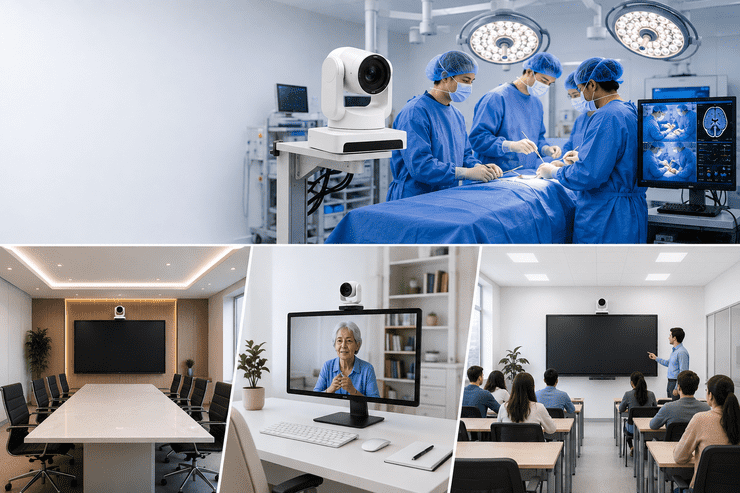
Inside a modern operation theatre, every angle and every second matters. That's where PTZ (Pan-Tilt-Zoom) cameras come in — quietly powering some of the most critical visual technology in healthcare today. From broadcasting live surgeries to specialists across the world, to connecting rural patients with city doctors, to training the next generation of medical students, PTZ cameras have become indispensable in hospitals and clinics.
This guide explains what PTZ cameras are, how they're used across healthcare settings, and what to look for when choosing one for your facility.
A PTZ camera is a video camera that can be remotely controlled to pan (move left/right), tilt (move up/down), and zoom (get closer or wider) — all without anyone physically touching the camera. In a healthcare setting, this means a single camera can be repositioned mid-procedure or mid-consultation to capture exactly the right view, controlled from outside the sterile field.
Unlike fixed cameras, PTZ systems offer the flexibility to follow movement, focus on fine detail, and adapt to different room layouts — all critical in fast-moving clinical environments.
PTZ cameras mounted in operation theatres allow surgical procedures to be streamed live to lecture halls, remote specialists, or conference audiences — without disrupting the sterile environment. Surgeons or a control room operator can zoom in on precise movements for detailed observation.
In telemedicine setups, PTZ cameras give remote doctors better control during video consultations. A specialist can zoom in to examine a specific area more closely, rather than relying on a fixed, static camera view — improving diagnostic accuracy during virtual visits.
Medical colleges and hospitals use PTZ cameras to record and stream procedures for teaching purposes. Students can observe surgeries from multiple angles in real time or review recorded sessions later, without needing to be physically present in the OT.
When multiple departments need to weigh in on a complex case, PTZ cameras in conference or consultation rooms allow remote specialists to join discussions and get a clear, adjustable view of imaging, reports, or the patient area.
Some facilities use PTZ cameras for remote patient monitoring, allowing nursing staff or family members (with appropriate privacy safeguards) to check in without constant physical presence in the room.
| Factor | PTZ Camera | Fixed Camera |
|---|---|---|
| Flexibility | Remotely adjustable angle and zoom | Fixed single view only |
| Sterile Field Control | Operable without touching camera | May require manual repositioning |
| Detail Capture | Can zoom into fine surgical detail | Limited by fixed focal length |
| Multi-Purpose Use | One camera can serve several viewing needs | Often needs multiple cameras for coverage |
| Remote Operability | Controlled from a separate room or device | Little to no remote control |
Homeify Smart helps hospitals, clinics, and medical colleges across Bangalore integrate PTZ camera systems into their AV infrastructure. Our services include:
Q1. Can PTZ cameras be used safely in a sterile operation theatre? Yes, PTZ cameras are designed to be operated remotely, meaning staff don't need to touch the camera during a procedure, keeping the sterile field intact.
Q2. Do PTZ cameras support live streaming to multiple locations at once? Yes, when paired with the right conferencing or streaming software, PTZ camera feeds can be shared with multiple remote viewers simultaneously.
Q3. Is the video quality good enough for detailed surgical observation? Modern healthcare-grade PTZ cameras typically offer HD or 4K resolution with optical zoom, providing clear detail suitable for surgical broadcasting and training.
Q4. Can PTZ cameras integrate with telemedicine platforms? Yes, most PTZ cameras are compatible with common video conferencing and telemedicine software used for remote consultations.
Q5. Does Homeify Smart install PTZ camera systems for hospitals in Bangalore? Yes, Homeify Smart provides consultation, installation, and support for PTZ camera systems across hospitals and clinics in Bangalore.
PTZ cameras have quietly become one of the most valuable AV tools in modern healthcare — enabling live surgery broadcasting, sharper telemedicine consultations, and richer medical training experiences. As hospitals continue to embrace remote collaboration and digital learning, investing in the right PTZ camera setup is a practical step toward better patient care and medical education.
Looking to bring PTZ camera technology into your hospital or clinic? Homeify Smart offers expert consultation and installation across Bangalore. Get in touch today for a free facility assessment.

Delivering advanced audio-visual and smart technology solutions to create future-ready environments.
© Homeify Smart 2026 | All Rights Reserved