

We provide advanced audio-visual technologies to create future-ready corporate, educational, and healthcare environments.
We provide advanced audio-visual technologies to create future-ready corporate, educational, and healthcare environments.

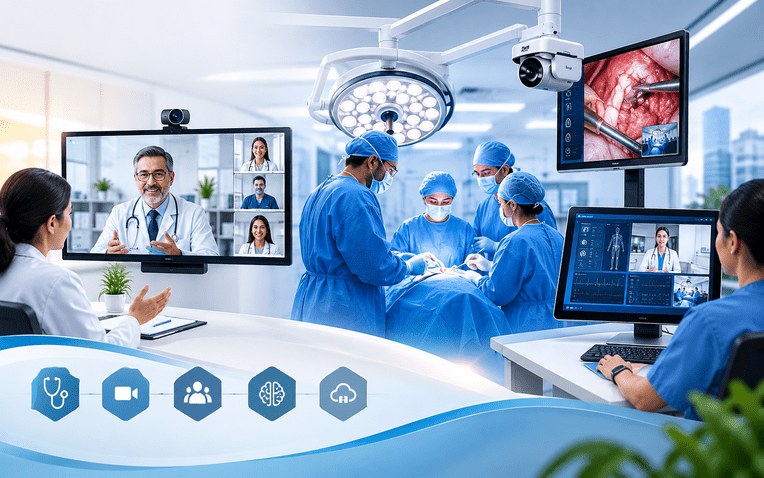
Not long ago, a hospital visit meant waiting rooms with paper tokens, x-rays on physical film, and consultations that only happened in person. Today, that picture looks very different. Patients video-call their doctors from home, surgeons broadcast procedures to specialists on another continent, and digital screens guide visitors through sprawling hospital campuses.
This shift didn't happen overnight — it's the result of AV (audio-visual) technology steadily reshaping how healthcare is delivered, taught, and experienced. Here's a look at how that transformation is playing out, and what it means for hospitals, clinics, and patients alike.
Perhaps the biggest shift AV technology has enabled is location independence. Video consultation tools now let patients connect with doctors without traveling — a major advantage for people in remote areas or those with mobility challenges. Specialists, too, are no longer limited to consulting only within their own hospital; a cardiologist in one city can review a case with a rural clinic hundreds of kilometers away in real time.
This shift hasn't just added convenience — it's expanded access to specialized care that many patients previously couldn't reach at all.
In operation theatres and ICUs, timing matters. AV tools like high-definition displays and PTZ cameras now let surgical teams share live visuals with colleagues elsewhere, get a second opinion mid-procedure, or record sessions for later case review. Instead of decisions resting on memory or verbal description alone, teams can now see exactly what's happening, when it matters most.
This kind of real-time visual collaboration has made complex procedures more coordinated and, in many cases, safer.
Walk into a hospital lobby today, and AV technology is often the first thing you notice — digital signage showing wait times, wayfinding screens guiding patients to the right department, and queue management displays reducing the chaos of manual token systems.
Inside patient rooms, in-room displays now let patients access information about their treatment, request assistance, or simply stay entertained during recovery — small changes that add up to a noticeably better hospital stay.
Medical education has traditionally relied on physical presence — students crowding around an operating table to observe. AV technology has changed that model. Live-streamed surgeries, recorded procedures, and interactive training displays now let students learn from multiple angles, review sessions repeatedly, and even participate remotely from a lecture hall or another campus entirely.
This has made high-quality medical training more scalable, without compromising the depth of learning.
A few trends are shaping what comes next for AV in healthcare:
For healthcare facilities considering where to start, the transformation doesn't need to happen all at once. Common starting points include:
Starting with the areas that create the most immediate impact — often patient-facing spaces or high-use consultation rooms — makes the transition manageable rather than overwhelming.
Homeify Smart works with hospitals and clinics across Bangalore to plan and implement AV upgrades that fit real clinical workflows, not just showcase technology for its own sake. We offer:
Q1. Is AV technology only useful for large hospitals? No, even small clinics benefit significantly from basics like video consultation tools and digital signage, often with a lower upfront investment.
Q2. How does AV technology improve patient care specifically? It enables remote access to specialists, reduces waiting-room confusion, supports better-informed surgical decisions, and improves overall communication between patients and staff.
Q3. Do these upgrades require a complete infrastructure overhaul? Not usually. Most facilities start with targeted upgrades — like a consultation room or waiting area — and expand over time.
Q4. What's typically the first AV upgrade hospitals invest in? Video consultation and telemedicine setups are often the starting point, since they address a clear, immediate need for remote patient access.
Q5. Does Homeify Smart help plan healthcare AV upgrades in phases? Yes, Homeify Smart works with facilities in Bangalore to plan phased AV implementations based on priority and budget.
AV technology has quietly become one of the most influential forces reshaping modern healthcare — expanding access to care, improving precision in critical moments, and making medical training more scalable than ever. As hospitals and clinics continue this shift, the facilities that adapt thoughtfully stand to offer better outcomes for both patients and staff.
Ready to explore how AV technology can support your facility? Homeify Smart offers expert consultation across Bangalore. Reach out today to start the conversation.

Delivering advanced audio-visual and smart technology solutions to create future-ready environments.
© Homeify Smart 2026 | All Rights Reserved