

We provide advanced audio-visual technologies to create future-ready corporate, educational, and healthcare environments.
We provide advanced audio-visual technologies to create future-ready corporate, educational, and healthcare environments.

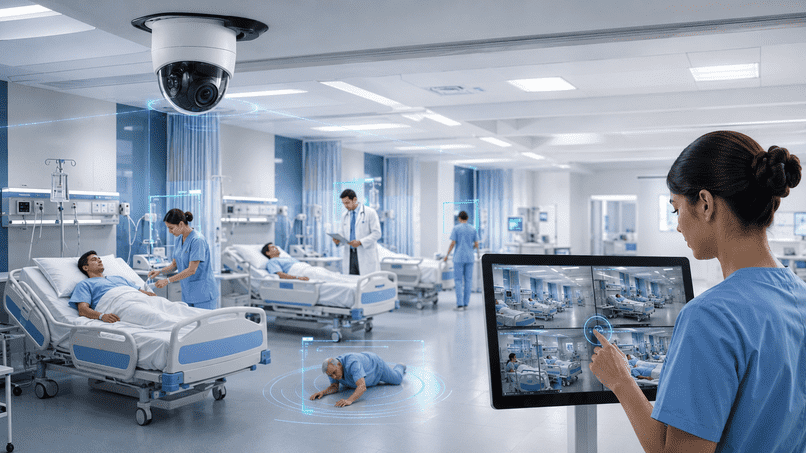
By now, most hospital administrators have heard that AI cameras can improve patient safety. What's less clear, often, is exactly which features actually matter — and which are just marketing add-ons. With so many vendors offering overlapping capabilities under different names, it's easy for decision-makers to get lost comparing spec sheets instead of understanding what genuinely improves care.
This guide takes a step back and lays out the core AI camera features hospitals should actually evaluate — explained in plain terms, so you can compare systems with confidence rather than guesswork.
It's worth clarifying upfront: not all AI-powered hospital cameras do the same job. Some are built for movement and fall detection. Others focus on facial or eye analysis. Some combine several capabilities into one system. Understanding the individual features — rather than treating "AI camera" as a single product category — is the key to choosing the right solution for your facility.
Identifies when a patient is at risk of falling — such as attempting to get out of bed unassisted — and alerts staff before or immediately after it happens. This is often the starting point for hospitals adopting AI monitoring, given how common and dangerous falls are in clinical settings.
A more specific version of fall prevention, this feature flags the moment a patient begins to leave their bed, giving staff time to intervene, especially valuable for patients with mobility restrictions or cognitive impairment.
Detects signs of pain or discomfort through facial cues, particularly useful for patients who can't verbally communicate, such as those who are sedated, intubated, or non-verbal.
Monitors eye openness and blink patterns to assess consciousness levels or drowsiness — useful in post-anesthesia recovery and sedation monitoring.
Ensures consistent detection accuracy at night, when staffing levels are often lower and incidents can go unnoticed longer without visible-light dependency.
Identifies unusual patterns like wandering, agitation, or prolonged inactivity — relevant for dementia care, behavioral health wards, and long-stay patients.
Determines how quickly and through what channel staff are notified — a dashboard alert, a mobile notification, or integration with existing nurse call systems.
Some systems use skeletal or pose-tracking instead of clear facial video, reducing privacy concerns while still detecting relevant movement patterns.
Allows staff to review footage or event logs after an incident for documentation, quality review, or training purposes.
The ability to connect with existing nurse call systems, electronic health records, or hospital management software, rather than functioning as an isolated tool.
| Feature | Best Suited For | Key Benefit |
|---|---|---|
| Fall Detection | General wards, elderly care | Reduces injury from unassisted falls |
| Bed-Exit Alerts | Post-surgical, cognitive care wards | Early intervention before a fall occurs |
| Facial Distress Analysis | ICU, non-verbal patients | Identifies pain/discomfort without verbal input |
| Eye Movement Tracking | Post-anesthesia, sedation units | Monitors consciousness and alertness |
| Low-Light Monitoring | Night-shift wards | Maintains accuracy without disturbing patients |
| Behavior Pattern Recognition | Dementia/behavioral wards | Flags wandering or agitation early |
| Privacy-Preserving Detection | All patient areas | Balances safety with patient dignity |
Not every hospital needs every feature from day one. A practical approach is to match features to your highest-risk areas first:
Asking these questions directly often reveals more about a system's real-world reliability than a feature list alone.
Homeify Smart helps hospitals across Bangalore cut through the noise and choose AI camera systems that genuinely fit their clinical needs. Our services include:
Q1. Do I need all these AI camera features, or just a few? Most hospitals don't need every feature at once — it's better to start with the capabilities that address your highest-risk wards and expand from there.
Q2. How is facial distress detection different from standard patient monitoring? Standard monitoring often focuses on movement and location, while facial distress detection specifically analyzes expressions to identify pain or discomfort, especially useful for non-verbal patients.
Q3. Are privacy-preserving detection methods less accurate than standard video? Not necessarily — pose and skeletal tracking systems are specifically designed to maintain detection accuracy while reducing identifiable video capture.
Q4. How long does it typically take to implement an AI camera system in a hospital? Timelines vary based on facility size and scope, but many hospitals start with a pilot ward, which can often be implemented within a few weeks.
Q5. Does Homeify Smart help hospitals in Bangalore choose the right AI camera features? Yes, Homeify Smart provides vendor-neutral consultation to help hospitals across Bangalore identify and implement the AI camera features best suited to their needs.
AI camera technology in hospitals isn't a single product — it's a collection of distinct features, each suited to different risks and wards. Understanding what each feature actually does, and matching it to your facility's real needs, is far more valuable than chasing the system with the most impressive spec sheet.
Delivering advanced audio-visual and smart technology solutions to create future-ready environments.
© Homeify Smart 2026 | All Rights Reserved