

We provide advanced audio-visual technologies to create future-ready corporate, educational, and healthcare environments.
We provide advanced audio-visual technologies to create future-ready corporate, educational, and healthcare environments.

Meta Title: AI Face & Eye Tracking in Hospitals | Homeify Smart Meta Description: Learn how AI face & eye tracking technology supports smarter, round-the-clock patient monitoring in hospitals. Guide by Homeify Smart Bangalore. Meta Keywords: AI face tracking hospital Bangalore, eye tracking patient monitoring, AI facial recognition healthcare Bangalore, night vision patient monitoring, consciousness detection AI camera, smart ward camera Bangalore, Homeify Smart Bangalore
Not every sign that a patient needs help is as obvious as a fall. Sometimes it's a change in facial expression, a patient struggling to keep their eyes open when they shouldn't be, or subtle signs of discomfort that a busy nursing team might miss between rounds. This is where AI face and eye tracking technology is starting to play a role — adding a finer layer of observation to hospital monitoring, one that works just as reliably at 3 AM as it does at midday.
This guide looks at how face and eye tracking AI works in a clinical setting, where it's proving useful, and what hospitals should know before adopting it.
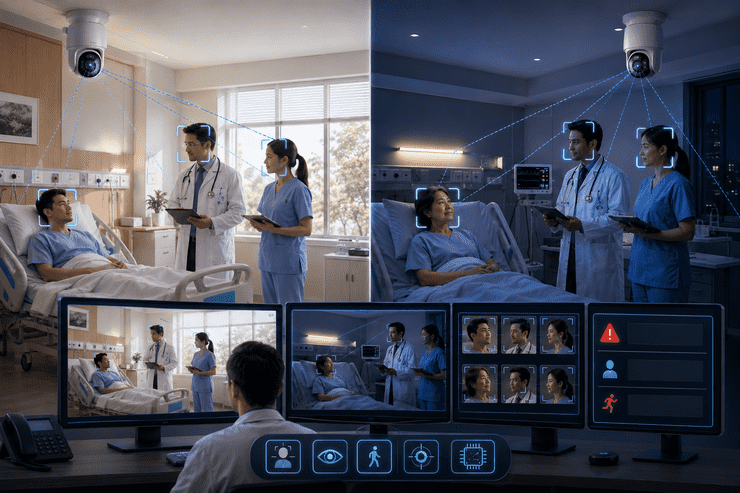
AI face and eye tracking uses camera-based software to analyze facial cues and eye movement in real time. Unlike general motion-detection cameras, this technology focuses specifically on:
The system doesn't just "see" a face — it interprets specific patterns within it, flagging changes that might otherwise go unnoticed during a quick visual check.
One of the most practical advantages of this technology is consistency across lighting conditions:
This day-night consistency matters because many critical changes in a patient's condition don't wait for convenient lighting or shift changes.
Tracking eye responsiveness helps staff monitor how a patient is emerging from sedation or anesthesia, flagging unexpected delays or complications sooner.
Facial expression analysis can help identify signs of pain or distress in patients who are unable to communicate verbally, such as those on ventilators.
Eye movement patterns can offer early indicators relevant to certain neurological conditions, supporting — though not replacing — clinical assessment.
For patients where alertness levels need tracking over time, eye-tracking data can help identify unusual patterns worth a closer look.
Since infrared-capable systems work without visible light, they allow continuous, non-disruptive monitoring overnight — a time when staff-to-patient ratios are often lower.
Facial monitoring technology naturally raises more privacy sensitivity than general motion detection, so it's worth addressing directly:
Choosing a vendor that treats privacy as a core design principle — not an afterthought — matters as much as the accuracy of the technology itself.
| Feature | Why It Matters |
|---|---|
| Infrared / Low-Light Capability | Ensures accurate tracking during nighttime hours |
| Real-Time Alerting | Speed of notification directly affects response time |
| Configurable Sensitivity | Allows tuning for different ward types and patient conditions |
| Privacy-First Data Handling | Reduces long-term storage of identifiable footage where possible |
| Integration with Nurse Call Systems | Ensures alerts reach staff through existing workflows |
| Clinical Validation | Look for systems tested or validated in real healthcare settings, not just general-purpose AI cameras |
Homeify Smart helps hospitals across Bangalore evaluate and implement AI-based monitoring technology thoughtfully, with clinical workflow and privacy front of mind. Our services include:
Q1. How is face and eye tracking different from general patient monitoring cameras? General monitoring cameras typically focus on movement and falls, while face and eye tracking specifically analyzes facial expressions and eye behavior to detect subtler signs like distress, drowsiness, or reduced alertness.
Q2. Does this technology work in low-light or nighttime conditions? Yes, systems designed for healthcare use typically include infrared or low-light capability, allowing consistent tracking accuracy around the clock.
Q3. Can this technology diagnose medical conditions on its own? No, it's designed to flag patterns worth attention — final clinical assessment and diagnosis always remain the responsibility of trained medical staff.
Q4. How is patient privacy protected with facial monitoring? Reputable systems are designed to focus on pattern detection rather than long-term identifiable data storage, with strict access controls and clear hospital data policies.
Q5. Does Homeify Smart implement AI face and eye tracking systems for hospitals in Bangalore? Yes, Homeify Smart provides consultation, installation, and support for AI-based patient monitoring systems, including face and eye tracking technology, across hospitals in Bangalore.
AI face and eye tracking technology adds a more nuanced layer to hospital monitoring — one that can catch subtle signs of distress or reduced alertness that might otherwise go unnoticed, day or night. Implemented thoughtfully, with privacy and clinical workflow at the center, it offers a meaningful way to support nursing teams in providing safer, more attentive patient care.
Exploring AI-powered monitoring solutions for your hospital wards? Homeify Smart offers expert consultation and installation across Bangalore. Get in touch today for a facility assessment.

Delivering advanced audio-visual and smart technology solutions to create future-ready environments.
© Homeify Smart 2026 | All Rights Reserved